R134a Refrigerant Charts: A Comprehensive Guide
Navigating R134a charts, often found as PDFs online, is crucial for HVACR professionals, utilizing NIST data for accurate pressure-temperature assessments and system diagnostics.
Understanding R134a and its Applications

R134a, a hydrofluorocarbon (HFC) refrigerant, gained prominence as a replacement for ozone-depleting substances, finding widespread use in automotive air conditioning systems, residential refrigerators, and commercial refrigeration equipment. Its favorable thermodynamic properties and non-flammability contributed to its adoption. However, R134a possesses a significant global warming potential (GWP), prompting a shift towards lower-GWP alternatives.
Understanding its behavior requires utilizing accurate R134a charts, often available as PDFs online, derived from databases like NIST REFPROP. These charts detail the relationship between pressure, temperature, and other thermodynamic properties, essential for system performance analysis and troubleshooting. Proper application necessitates adherence to safety guidelines and consideration of environmental impact.
The Importance of R134a Charts
R134a charts are indispensable tools for HVACR technicians, enabling accurate system diagnosis, performance evaluation, and efficient refrigerant management. These charts, frequently accessed as PDFs online, provide critical data relating pressure and temperature, vital for identifying issues like leaks, restrictions, or compressor inefficiencies.
Utilizing data from sources like NIST REFPROP, these charts allow for precise calculations of superheat and subcooling, key indicators of system health. Incorrect refrigerant charge or system malfunctions manifest as deviations from expected chart values. Accessing reliable, readily available R134a charts ensures safe and effective servicing, minimizing downtime and maximizing system longevity;

R134a Pressure-Temperature (PT) Charts
PT charts graphically represent the relationship between R134a pressure and temperature, essential for diagnosing system performance and identifying refrigerant states.
Reading a Standard R134a PT Chart
Understanding an R134a pressure-temperature (PT) chart is fundamental for HVACR technicians. These charts, readily available as PDFs online, typically display pressure on the vertical axis (often in psig) and temperature on the horizontal axis (in Fahrenheit or Celsius). The curved line represents the saturation temperature corresponding to a given pressure.
Points above the curve indicate superheated vapor, while points below represent subcooled liquid. Identifying the state of the refrigerant – liquid, vapor, or a mixture – is crucial for accurate system analysis. Charts often include markings for atmospheric pressure and indicate values below atmospheric pressure with red italics.
Accurate chart interpretation, utilizing data from sources like NIST REFPROP, allows for precise diagnosis of system issues and efficient refrigerant handling. Remember to always consult reliable sources for chart accuracy.
Saturation Pressure vs. Temperature
The relationship between saturation pressure and temperature for R134a is critical. As temperature increases, the saturation pressure also rises, and vice versa – a direct correlation visually represented on PT charts, often accessible as PDFs online. This curve defines the boiling point of R134a at various pressures.
Understanding this relationship is vital for determining if the refrigerant is boiling or condensing within the system. Accurate data, sourced from NIST REFPROP, ensures precise readings. Deviations from the expected pressure-temperature relationship can indicate system problems like overcharging or restrictions.
Properly interpreting this data, found on readily available charts, allows technicians to assess system performance and diagnose issues effectively, ensuring optimal cooling or heating efficiency.
Superheat and Subcooling on the Chart

Superheat and subcooling are essential concepts visualized on R134a PT charts, frequently available as downloadable PDFs. Superheat, measured at the evaporator outlet, indicates the refrigerant is fully vaporized, preventing liquid from entering the compressor. Subcooling, measured at the condenser outlet, ensures the refrigerant is fully condensed, maximizing system efficiency.
Charts allow technicians to determine these values by comparing actual system pressures and temperatures to the saturation curve. Proper superheat and subcooling levels, guided by manufacturer specifications and NIST data, are crucial for optimal performance.
Incorrect values signal potential issues – low superheat suggests liquid floodback, while low subcooling indicates insufficient condenser capacity. Utilizing online resources and charts aids in accurate diagnosis and effective system adjustments.

R134a Property Tables & Data Sources
Reliable R134a data originates from sources like NIST REFPROP, providing comprehensive tables (C-1, C-2, C-3) for accurate thermodynamic property analysis.
NIST REFPROP Database – The Gold Standard
The National Institute of Standards and Technology (NIST) REFPROP database stands as the definitive resource for thermophysical properties of refrigerants, including R134a. Version 9.0, developed by Lemmon, Huber, and McLinden, provides unparalleled accuracy across a wide range of temperatures and pressures.
REFPROP’s robust equations of state, specifically the Modified BWR (MBWR) equation, ensure precise calculations for critical applications. This database serves as the foundation for generating R134a charts and tables commonly found online, including those available in PDF format.
Its comprehensive data, encompassing saturated and superheated vapor properties, is essential for HVACR professionals needing reliable thermodynamic information for system design, performance analysis, and troubleshooting. Utilizing REFPROP-derived data guarantees consistency and accuracy in refrigerant calculations.
Saturated Liquid and Vapor Data (Tables C-1 & C-2)
NIST REFPROP’s Tables C-1 and C-2 provide fundamental saturated properties of R134a, crucial for understanding refrigerant behavior during phase changes. Table C-1 organizes data at consistent temperature intervals, allowing quick lookup of properties like specific volume, internal energy, enthalpy, and entropy at specific temperatures.
Conversely, Table C-2 presents the same properties arranged by consistent pressure intervals, facilitating analysis based on system pressure. These tables are foundational for constructing R134a pressure-temperature (PT) charts, often available as downloadable PDFs online.
Understanding the distinction between these tables – temperature-based versus pressure-based – is vital for accurate refrigerant system diagnosis and performance evaluation, ensuring reliable data for calculations.
Superheated Vapor Data (Table C-3)
NIST REFPROP’s Table C-3 details the thermodynamic properties of R134a in its superheated vapor state, extending beyond the saturation curve. This table presents data across a matrix of temperatures and pressures, offering a comprehensive view of R134a’s behavior when entirely vaporized and heated further.
Properties like specific volume, internal energy, enthalpy, and entropy are meticulously documented, enabling precise calculations for superheat determination and system performance analysis. Finding this data within comprehensive R134a charts, often available as PDFs online, is essential for HVACR professionals.
Accurate superheat calculations, utilizing Table C-3 data, are critical for optimizing system efficiency and preventing liquid refrigerant from entering the compressor.
Key Thermodynamic Properties in R134a Charts
R134a charts detail crucial properties—specific volume, internal energy, enthalpy, and entropy— vital for accurate system analysis and performance evaluations, often found in PDF formats.
Specific Volume
Specific volume, a fundamental property within R134a charts, represents the volume occupied by a unit mass of the refrigerant. It’s expressed in cubic feet per pound (ft³/lb) or cubic meters per kilogram (m³/kg) and varies significantly with pressure and temperature.
Understanding specific volume is critical for calculating refrigerant density and determining the size of components like accumulators and receivers within an HVACR system. Charts, often available as PDFs online utilizing NIST data, provide specific volume values for both saturated liquid and vapor phases, as well as superheated vapor states.
Accurate specific volume data, sourced from databases like NIST REFPROP, is essential for precise system modeling, performance analysis, and troubleshooting. Changes in specific volume directly impact system efficiency and capacity, making it a key parameter for technicians and engineers.
Internal Energy
Internal energy (U) for R134a, detailed in charts and PDFs sourced from NIST REFPROP data, represents the total energy contained within the refrigerant substance. This includes kinetic and potential energies of its molecules. It’s typically expressed in British thermal units per pound (BTU/lb) or kilojoules per kilogram (kJ/kg).
Internal energy values are crucial for performing energy balance calculations within refrigeration cycles. Charts delineate internal energy for saturated liquid, saturated vapor, and superheated vapor states, enabling precise determination of energy changes during phase transitions and temperature variations.
Accurate internal energy data, readily available online, is vital for analyzing system performance, identifying inefficiencies, and optimizing refrigerant charge. Understanding these properties allows for effective diagnosis and repair of HVACR equipment.
Enthalpy
Enthalpy (H) for R134a, meticulously documented in NIST REFPROP-based charts and accessible online as PDFs, signifies the total heat content of the refrigerant. It encompasses internal energy plus the product of pressure and specific volume, expressed in BTU/lb or kJ/kg.
Enthalpy differences are paramount in refrigeration cycle analysis, particularly when calculating the cooling effect and work input. Charts provide enthalpy values for various states – saturated liquid, saturated vapor, and superheated vapor – facilitating accurate determination of these critical parameters.
Utilizing precise enthalpy data, derived from reliable sources, is essential for performance evaluations, identifying energy losses, and optimizing system efficiency. Proper enthalpy calculations ensure effective HVACR system operation and maintenance.
Entropy
Entropy (S) for R134a, detailed in NIST REFPROP data and readily available through online charts and PDF resources, represents the measure of a system’s thermal energy unavailable for doing work. Expressed in BTU/lb·°R or kJ/kg·K, it’s a crucial thermodynamic property.
Entropy values are vital for assessing the reversibility of processes within the refrigeration cycle. Charts provide entropy data for saturated and superheated states, enabling calculations related to cycle efficiency and performance. Analyzing entropy changes helps pinpoint potential inefficiencies.
Accurate entropy determination, sourced from trusted databases like NIST, is fundamental for optimizing system design and troubleshooting operational issues. Utilizing these charts ensures precise analysis and effective HVACR system management.
Using R134a Charts for System Diagnosis
R134a charts, accessible online as PDFs, aid in diagnosing system faults by comparing actual readings to expected values, revealing issues like leaks or restrictions.
Identifying System Issues with PT Charts
Utilizing R134a pressure-temperature (PT) charts, often available as downloadable PDFs online, is fundamental for pinpointing refrigeration system malfunctions. Deviations from expected pressure readings at a given temperature immediately signal potential problems. For instance, abnormally low pressure could indicate a refrigerant leak, while excessively high pressure might suggest a restriction in the system, like a clogged filter drier or a malfunctioning expansion valve.
Comparing observed values against the chart allows technicians to assess superheat and subcooling, critical indicators of system efficiency. Incorrect superheat or subcooling values often point to issues with refrigerant charge, metering devices, or airflow. These charts, based on NIST data, provide a reliable baseline for accurate diagnosis, ensuring effective repairs and optimal system performance. Accessing these resources online streamlines the troubleshooting process.
Calculating Superheat and Subcooling for Performance Analysis
Accurate performance analysis of R134a systems relies heavily on calculating superheat and subcooling, easily facilitated using PT charts – frequently found as accessible PDFs online. Superheat, the temperature difference between the refrigerant vapor and its saturation temperature at the evaporator outlet, reveals refrigerant boil-off completeness. Subcooling, the temperature difference between the liquid refrigerant and its saturation temperature at the condenser outlet, indicates liquid refrigerant quality.
These calculations, guided by data from sources like NIST REFPROP, help determine if the refrigerant charge is correct and if the expansion device is functioning optimally. Deviations from manufacturer specifications, readily cross-referenced with online charts, signal potential issues. Proper superheat and subcooling ensure efficient heat transfer and prevent compressor damage, maximizing system lifespan and energy efficiency.
Online R134a Chart Resources & PDF Availability
Numerous websites offer R134a charts, including downloadable PDFs, providing convenient access to crucial pressure-temperature data for efficient system diagnosis and maintenance.
Reliable Websites for R134a Charts
Locating dependable R134a charts online requires discerning sources. Several websites consistently provide accurate and accessible resources for HVACR professionals and enthusiasts. Refrigerant Guys offers a readily available PT chart, clearly indicating pressure readings in both psig and inches of mercury. A-Gas provides system-specific advice alongside their charts, emphasizing guidance rather than definitive solutions.
Crucially, data originates from the NIST Standard Reference Database 23 (REFPROP), ensuring a high degree of accuracy. While numerous sites host PDFs, verifying the source’s connection to NIST or reputable HVACR organizations is paramount. Always cross-reference data when possible, and remember that online resources should supplement, not replace, professional training and experience. Websites offering charts based on the NIST database, like those referencing Lemmon, Huber, and McLinden’s work, are generally considered trustworthy.
Finding and Utilizing PDF Versions of R134a Charts
PDF versions of R134a charts offer portability and offline access, proving invaluable for field service work. Numerous websites host downloadable charts, often derived from NIST REFPROP data (Lemmon, Huber, McLinden). When searching, prioritize PDFs clearly stating their NIST origin or referencing the database directly. Ensure the PDF includes saturation pressure-temperature data, specific volume, internal energy, enthalpy, and entropy tables (Tables C-1, C-2, and C-3).
Carefully examine the chart’s units – psig is standard, but some charts may include inches of mercury. Always verify the chart’s applicability to your specific system and operating conditions. Remember that online PDFs should be considered supplemental; professional training and understanding of thermodynamic principles are essential for accurate interpretation and safe system diagnosis.

Safety Considerations When Working with R134a
Proper handling and storage of R134a are vital; understand pressure units (psig, inches of mercury) and always prioritize safety protocols during system servicing.
Proper Handling and Storage
Ensuring safe handling and storage of R134a refrigerant is paramount for both personnel safety and environmental responsibility. Always wear appropriate personal protective equipment, including gloves and eye protection, when working with the substance. Store R134a cylinders in a well-ventilated area, away from direct sunlight, heat sources, and ignition points.
Cylinders should be securely fastened to prevent tipping or rolling, and clearly labeled with hazard warnings. Avoid physical damage to the cylinders, as this could lead to leaks. When transporting R134a, adhere to all applicable regulations and ensure cylinders are properly secured.
Never attempt to repair or modify refrigerant containers. In the event of a leak, evacuate the area and follow established emergency procedures. Proper ventilation is crucial when charging or recovering R134a to prevent the buildup of potentially hazardous concentrations.
Understanding Pressure Units (psig, inches of mercury)
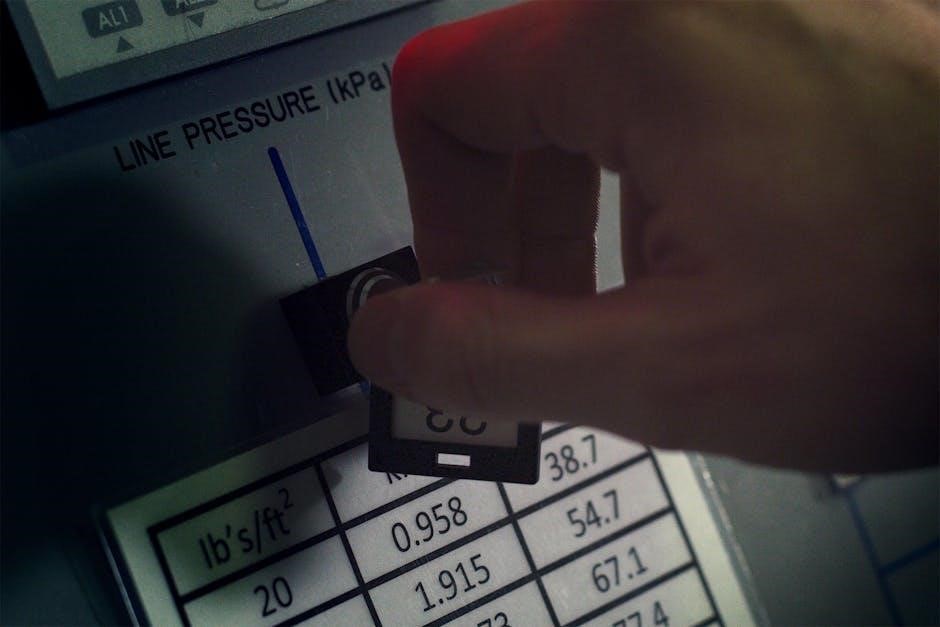
R134a charts commonly display pressures in two primary units: pounds per square inch gauge (psig) and inches of mercury (inHg). Psig measures pressure relative to atmospheric pressure, crucial for determining refrigerant state and system performance. A positive psig value indicates pressure above atmospheric, while a negative value (often shown in red italics on charts) signifies a vacuum or pressure below atmospheric.
Inches of mercury, historically used, represent pressure as the height of a mercury column. Understanding the conversion between these units is vital for accurate system diagnosis.
Charts often include data in both units for convenience. Correctly interpreting these values is essential for troubleshooting and ensuring optimal HVACR system operation, referencing reliable sources like NIST data for accurate conversions.